
Sizing
What Size Dumpster Do I Need? An Honest Local Guide
Most guides ask you to estimate cubic yards. Around here the answer usually turns on the driveway grade and whether there is rock in it.
Start with the material, not the number
Almost nobody can estimate their own debris in cubic yards, and guides that ask you to are not much help. We ask three things instead: what are you throwing out, roughly how much in terms you can picture, and where will the container sit.
In this market that third question carries more weight than it does almost anywhere, because a Draper driveway can be flat, or it can be a bench drive at a grade that decides the whole job.
Volume and weight, and which binds first
Every container has two limits and you will hit one first. Volume is obvious — you cannot load above the top rail. Weight is the one people forget and the one that costs money.
Each size includes a tonnage allowance: roughly one to two tons on a 10 yard, four to five on a 30. Past that you pay a per-ton overage, which we quote before you book.
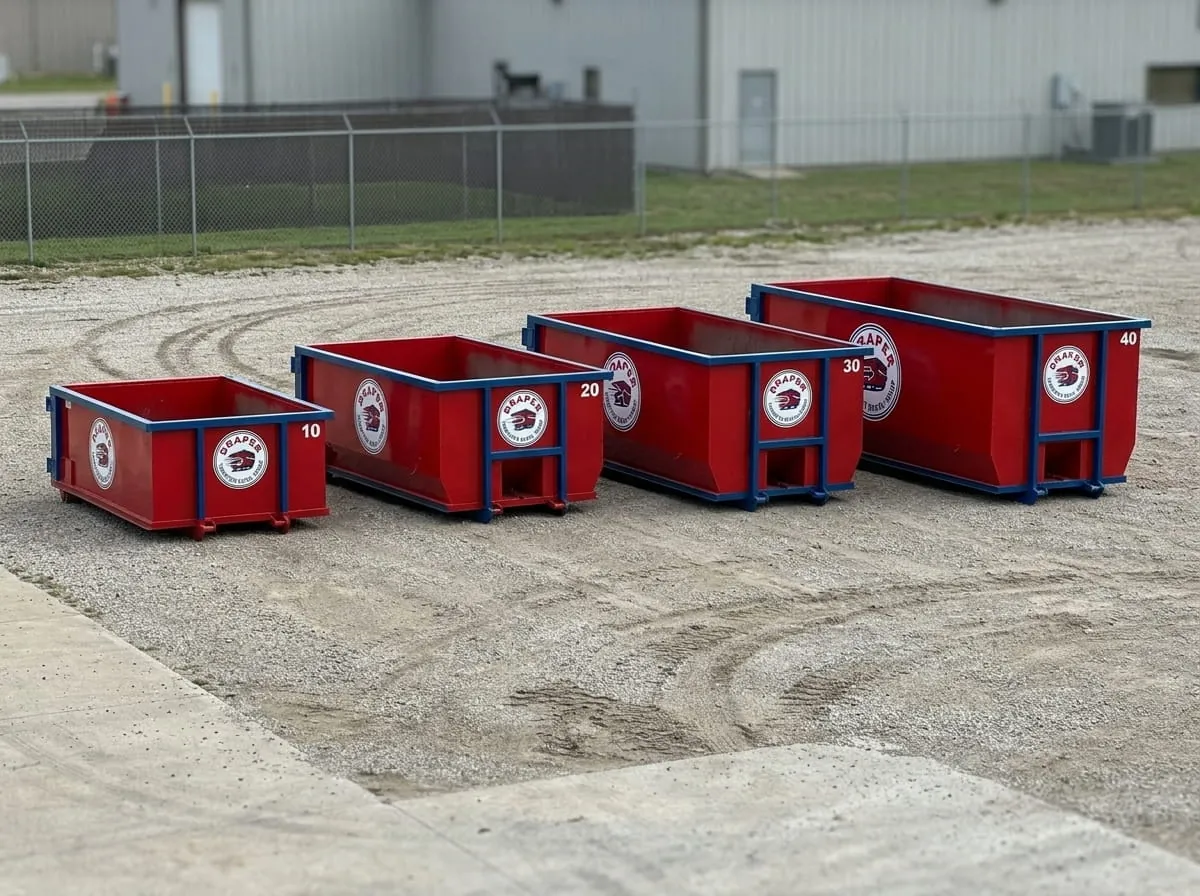
What each size really holds
10 yard — 12 ft × 8 ft × 3.5 ft
Three to four pickup loads, one to two tons. The small-job container and the heavy material container: concrete, brick, block, tile, mortar, soil and rock. Low sides mean you can throw material over the wall without a ramp.
15 yard — 16 ft × 8 ft × 4 ft
Five to six pickup loads, two to three tons. The under-used size, and the one we place most often on the older narrow streets of Midvale — and across the whole valley in winter, when snow banks take a foot off each side of every driveway.
20 yard — 22 ft × 8 ft × 4.5 ft
Seven to eight pickup loads, three to four tons. Our most common residential container, and the default across the newer subdivisions in Herriman, Lehi and Saratoga Springs where driveways are generous and flat.
30 yard — 22 ft × 8 ft × 6 ft
Ten to twelve pickup loads, four to five tons. Same footprint as the 20 with eighteen more inches of height, so it holds half again as much without needing more driveway. The right call for a whole-house clear-out, a big basement, or a job site.
Worked examples from local jobs
| Job | Size | Why |
|---|---|---|
| Bathroom renovation | 10 yard | Small volume; tile and cast iron are dense |
| Driveway or patio slab removal | 10 yard | Concrete runs ~2 tons per cubic yard |
| Xeriscape conversion (sod + rock) | 10 yard, part filled | Soil and rock are as heavy as it gets |
| Older narrow street, any job | 15 yard | Access is the limit, not volume |
| Steep bench driveway | 15 yard | Grade limits what we can safely set down |
| Any driveway job in winter | 15 yard + swap | Snow banks narrow the approach |
| Kitchen renovation | 15–20 yard | Cabinetry eats volume; tile drives weight |
| Composition re-roof, 24 squares | 20 yard | Around 4 tons — at the allowance |
| Full garage clear-out | 20 yard | Bulky and light — volume binds first |
| Mature tree removal | 20–30 yard | Cut it down first; it halves the volume |
| Deck or fence demolition | 20 yard | Treated timber; heavier than it looks |
| Three-bed whole-house clear-out | 30 yard | Contents fill volume before weight |
| New construction offcuts | 20–30 yard | Bulky and light |
| Rental turnover | 15–20 yard | Mixed household and construction debris |
| Full landscape rebuild | 30 yard + swap | Mixed, and heavier than anyone expects |
⚠️ Grade and access on the bench
The local variable that most often changes the answer, and the one that genuinely differs from a flat market.
Draper climbs from the valley floor up onto the bench, and so do Cottonwood Heights, Alpine and Cedar Hills. A loaded roll-off on a steep drive has to climb it, stop on it, set several tons down on it and later drag that weight back off.
- Steep drives often take a smaller container. Not because of volume but because of what the truck can safely do.
- A flatter placement may serve you better even if it means a longer carry. A container we can collect beats one we cannot.
- Long or winding approaches — common in Alpine — need describing before delivery day.
- Overhead clearance of roughly twenty-two feet to raise the bed. Mature canopy over the older streets of Midvale and Murray is genuinely low in places.
- New concrete is everywhere in the growth cities and needs to cure before it takes a loaded container. Boards go down regardless.
Soil, rock and heavy debris
The local wrinkle on the other side of the scale, and it has got more relevant.
Landscaping here means gravel, decorative rock, boulders and sod — and since the green waste program closed, all of it is priced as ordinary waste by weight.
- Soil and rock go in a 10 yard, part filled. They will reach the weight allowance while the container still looks half empty.
- Keep masonry clean and separate. Concrete, brick, block and stone have their own cheaper disposal route — but only if the load is not contaminated with timber and household material.
- Landscape ties are not green waste. Heavily treated, very heavy, container job.
- Do not judge by eye. The most common overage we see is somebody looking at a half-full container of rock and adding more.
Winter changes the answer
- Snow banks narrow a driveway by a foot or more each side, turning a 20 yard placement into a 15 yard one.
- Ice on a bench drive is the real limit, not the snow itself.
- A container can freeze to the ground. Boards help considerably.
- Snow in an open container is weight you pay for. Ask about a cover.
- Canyon wind moves light debris — load it low with heavy material over it.
There is a full winter guide here, and it is worth reading before booking anything between November and March.
How to describe your job on the phone
- What the material is. "Kitchen cabinets, countertop, appliances and 200 square feet of tile" tells us everything.
- Whether there is soil, rock, concrete or tile. Those get their own small container.
- How steep the driveway is. The single most useful sentence in this market.
- Roughly when the house was built. Pre-1980 means testing before demolition.
- Which city — and which county, because we work across both.
- Driveway width, length, surface, age and any low branches.
- In winter, where the snow has been pushed.
Ninety seconds on the phone is the difference between a flat rate that holds and a truck that has to leave again.
Need a container in Draper?
Call and describe the job. Three minutes on the phone gets you a size recommendation, a flat rate and a delivery window — and we will tell you if a smaller, cheaper container is the right answer.
Call (385) 338-5583